
Friday, January 22, 2010

iPhone App Sites - Reviews, Price Charts and More

A few weeks ago my wife gave me an iTunes gift card and I went to town with the iTunes iPhone/iPod Touch app store. Even when I get a gift card, I try to stretch it out as much as possible by making purchases when items go on sale and by buying the best product for my needs. The question is how do you find out if something is on sale at the iTunes store and I discovered a few venues that help do just that.

  1. iPhone apps that alert you when something is on sale.
    • The apps:
      BargainBin With Push!
      I tend to favor this one because of its expandable/collapsible interface. It's somewhat clean and offers some nice features with its push technology. You can have the application alert you when a certain app you've been waiting to go on sale does so. Sometimes it's slow to use and there can be enough lag between its information updates that the app changes price in the store before you know about it.
      AppMiner (Save $$)
      This is a popular choice amongst these type of apps. It provides the app information and the first screenshot when you click on the app list. I find it a tad bit faster than BargainBin and it shows some apps that BargainBin misses.
      PandoraBox (Download Paid Apps for Free, now with Push)
      This app contains some other nice features missing in the other two. Namely, you can choose which categories to omit from its search. I don't care much for sports and the developers who write sports apps abuse the system by flooding the store, so I like to remove them from the list. This app also finds apps that the others miss.
      Free Apps - Find Paid Applications That Are On Sale - Powered By AppTrakr
      Haven't used this one yet. It's only been around for a couple of weeks.
    • Considerations
      Floods
      This is my biggest peeve and it always happens with apps that I could care less about. A developer decides to write a program that shows sports scores, but instead of writing one application that has two-dozen in-app add ons, he releases two-dozen distinct programs. Not only is this inefficient, it's inconsiderate and unimaginative. This affects our sale apps by bumping other good apps off the list and making you scroll several pages to see what's available.
      Freebies
      One of the great things these sale apps provide is access to the knowledge of what's free. The apps that have proven themselves are usually only free for a day or two while introductory apps or apps that aren't selling might go free for more extended periods of time.
      iTunes store API changes
      It's happened at least once - Apple decided to change the way they provide information for these apps. More than one of them quit working for a few days. One of the three top sale apps usually get updated to work again within a day... but you won't know which one until it happens, which is why it's a good idea to have the top three installed.
      iTunes store price change discrepencies
      Occasionally a developer sets the price of his app to blitz these search engines then quickly raises up the price. This bait and switch process doesn't happen often, but you should be aware. Furthermore, these sale apps usually cache old data and could be showing yesterday's sale price. Just be aware of that when you go to the actual iTunes store to make the purchase.
      Why have all three?
      They share about 95% of the same product which means about 5% of the apps differ between them. I'll find an app or two, across each day, in each program that doesn't appear in the others. Also, as mentioned above, if Apple changes their API you might not be able to use any of these apps at all until one of their developers post an update, which could take anywhere from one day to one week.
  2. iPhone websites that provide lists of products on sale.
    148 Apps
    They have an aesthetically pleasing site that's filled with icons, screen shots, reviews, lists of price drops and other niceties.
    AppShopper
    The clean interface and features on this site make it my favorite. I particularly like the App Activity box on each applications information page. This information is used to make purchase decisions in a timely manner to get the best price - I'll explain more later.
    UQuery
    This site offers a clean web-based search engine that ties to the iTunes app store. This is an area that iTunes lacks. Anyone who has searched for an application that fulfilled a purpose, say - "time management", on the iTunes app would know how valuable a good search engine can be. In this example the top 20 apps and 70% of the top 100 from an iTunes search returns games. In contrast, none of the top 20 apps and only 5% of the top 100 from UQuery are useless colorful drivel.
    Other sites.
    Websites are popping up all the time to help app developers gain exposure and users get good deals. free app a day, iPhone Application List, iPhone Promo Codes and Apptism are a few. Not all of these sites offer lists of price reduction, but they nearly all have some form of review board.
  3. Getting into the mind of the developer - when apps go on sale.
    Developers are after one of three things: money, fame and pride - but always pride.
    It costs $100 a year to be a part of the iPhone app developer program so that your apps may appear in the store. Pride usually comes to play regardless of whether money and fame are the goal. Developers pride themselves in coming up with original ideas, or with a well executed design, or a pleasant interface. That means they want feedback. Positive feedback to stroke an ego, and constructive feedback to become better developers (hopefully). Keep that in mind and be respectful when you download an app that you're drawn to reuse (especially if it was given away for free).
    When new updates come out that fix terrible problems.
    If an application is decent but has a glaring technical issue (such as crashing the iPhone) it will suddenly drop in rating. Purchasers of the product wail and complain even if the app were free when they got it. A common practice is for the developer to quickly come out with a fix, but this isn't always possible before enough bad reviews tarnishes his reputation. As a result, he fixes that problem but needs to garner a new set of better reviews. To do this the developer usually drops the price to attract new customers. It's not uncommon to even see the app go out for free for 24 hours.
    When a product isn't selling well.
    If an app isn't doing well in sales, it could be because it's too expensive. That's business 101. Reduce the price or give it away for free for a day or two and after you garner a few dozen new users, put the new fixed price somewhere between the original and the sale price. This will allow the app to build some exposure. For paid apps that only go on sale, it even means a few dollars that wouldn't have otherwise come that way.
    When a new product is introduced in a highly competitive market.
    Supply and demand. Why would someone want "product A" at twice the price of "product B" that does practically the same thing? Walmart did it and so do developers - they lowball each other to gain market share then when the competition is slow they bring up the price.
    Milestone Dates and Holidays
    Special milestones such as anniversaries and holidays strike a special emotional chord which might make a developer feel charitable. Keep a close eye on the app store during special events such as Black Friday, Earth Day and the like.
  4. A word about taxes.
    • They exist even in the iTunes store. It's based off of your profile's mailing address. Mine is around 3 or 4% but I've heard some states don't have it.
  5. How I decide on what apps to buy: Remember that AppShopper App Activity box feature I raved about? Here's where you use it.
    Existing Features
    If it does what I want, it's a no-brainer. Developers are people and even with the best of intentions there's a risk of promising a feature but not delivering. If you've been watching the developer's release notes and see a good track record, buy the app as soon as you hear mention of the feature you're aiming for. Otherwise, wait. Some awesome new app might come out tomorrow that blows this other out of the water.
    Frequency of updates
    If a developer updates frequently - say once a month or more - and it's an app that's been out for more than half a year, you've got a well supported app. If you see a developer that updates two or three times one month then skips a few months before applying another stream of updates, you still have a well supported app. If the developer updated the app one time or less and it's been out there for more than four months it's not well supported - check the reviews to see if people are complaining about unresolved bugs.
    Last update date
    If the app was just recently updated with features, prices could go up. Most developers don't raise the price but some do. If, however, the app was updated last month and activity or ranking is starting to taper off then the developer just might cut a break in the weeks ahead.
    Last update features
    Features are nice, but if they focus more on features than on fixes it could make an unstable product that you can't use. Look for a good mix of both. Lack of features shows a lack of understanding their market... there's always something to enhance.
    Price and Popularity Timeline
    Some of the app information pages - particularly of the more popular ones - at the AppShopper website contain a chart that shows how popular an app is in sales in both their category and overall. It also shows tick marks that identify updates and price changes. If its popularity is sliding down after being up for a while be prepared for a sale to happen.
    Reviews that rate the app low (1 to 3 stars)
    You're fishing for constructive criticism, not mindless bashing. Some people are just fat fingered or, well... a few fries short of a happy meal. When you see something constructive, check the version number of the app that was referenced. If it was fixed in a later version the developer is listening. That's a good sign.
    Other apps the developer has made (is he too spread out?)
    Most of the apps in the iTunes store are written by single white men who have limited time on their hands. Use your common sense to figure out if it's a company (like Electronic Arts) or a one-man business (like TLA Systems Ltd). If the developer is writing more than a few apps, he won't be able to maintain them all with updates and new features.
  6. What products did I purchase and how much did I pay and why?
    The Secret of Monkey Island: Special Edition - $3.99 (regularly $7.99)
    This 1990's adventure game has some of the best humor and play experience of any out there. Anyone who's played it knows what it means to fight like a dairy farmer.
    Zombieville USA - $1.99
    I enjoyed playing the lite version enough to pay for the full version. People are always picking my brain for real, so I thought having a virtual life would be entertaining.
    Ramp Champ - Voyage Pack - $0.99
    During the Christmas Season the wonderful Iconfactory gave away their $1.99 Ramp Champ game for free. I figured it would only be fair to patronize them by spending $1.99 in add-ons. This one allows you to hit Pirates and Aliens with skee balls. Good times!
    Scrabble - $2.99 (regularly $4.99)
    Electronic Arts had a great sale at the end of last year. This is one of the apps they reduced. I like scrabble and the Trivia Pursuit app was poorly supported (it seemed to charge users for useless add-ons) so I only bought this one.
    PhotoBuddy - $1.99
    I had dozens of photography utility apps to choose from. I wanted something that helped me calculate DOF, provide sunrise and sunset times and provide some guidelines when I'm in full manual mode. This one proved to be the most promising for the money. The other apps cost way too much more for the few extra features they offered. I enjoy the purchase so far.
    Pano - $1.99 (regularly $2.99)
    I like to use Hugin on the Mac or PC, but couldn't resist a tool that would let me play around with it on the iPhone. I've heard it works better on the first generation iPhones because they all have fixed focus while the newer second and third generation 3G iPhones have auto-focus, which could throw off the clarity of the stitching.
    AutoStitch Panorama - $1.99
    This program differs from Pano. Where Pano is akin to a Cinerama theater, AutoStitch is like an iMax. You can stitch multiple images to make a larger, more detailed flat scene. Although Hugin can also do this on the desktop computers, I don't expect Pano or AutoStitch to handle both types of stitching.
    2Do - $6.99
    This app shines like a polished shoe on a sunny day. There are features lacking, but the developer(s) on this project listen to users ideas and the app is well supported. I really didn't like how each revision meant another dollar mark-up. Within the month that I had my iTunes credit this app went up twice in price, meaning if I jumped in on it sooner I could have gotten it for $4.99 instead of $6.99. If they build in the features I want, it will be worth it. If they don't then it will be a lesson learned. It's a little gamble, but here's my reasoning. This developer group has a particular pricing style. They introduce an app at a price they think it will sell well for. If it doesn't sell like they expect then the price is lowered a dollar or two. Then with each update where features are added, the price goes up or stays the same depending on how extensive the features were and how many cumulative features have been added since the last price hike. Only if the app really stagnates does the price go back down. This app has been a hot item for over a month now, meaning it's not going to drop in popularity for some time, and that keeps the developers fat and happy. As a developer, myself, I think their efforts are worthy of being rewarded, though I still wish I paid less for it - but it's still worth the price.
    Ramp Champ - Adventure Pack - $0.99
    This is the last app/add-on I could buy because of the iTunes store taxes. It was too easy to solve because I've been playing one of their hardest packs. Still haven't solved all the points with the "Star Struck" level from their Adventure Pack. My advice would be to get easier packs, like this one, first and solve them before buying the harder Adventure Pack. It's still fun, though!

I hope you've learned a few things in this post - apps and sites that can save you money and how to save a few dollars when buying that four-star app. If you found this post helpful, please give a comment to let me know about it.

BTW - if you want to make cool links from your blog that point to the iTunes store, this is where I did mine: http://apple.com/itunes/linkmaker/

Cheers!

Tuesday, December 29, 2009

Why I don't write poetry anymore

Absent from the likeness of God,
some piece of myself whittled away
by my own hands in a moment.

What a shame, they might say.
Something in me demands;
it makes demands for
reconcealiation.

There's passion and hope,
rage and remorse,
then grief when it's lost
but the feelings will expire.

I hold onto things
old coupons that have no worth
a few cards from a misplaced deck
wishing for the time I lost.

Where's the meaning without the worth?
Time will whittle me away anyway.
Why not give myself, even in pieces.
Each of us - meaningless unless given away.

But life is an offer,
a limited time
a time that will expire.

Sunday, November 29, 2009

Happy Morning

In 2006, Folgers made what I consider to be one of the best commercials of all time. It was originally going to be featured during the Superbowl but rumor has it that upper management felt the commercial too annoyingly happy to do well. After all, the point of the commercial was that joyous morning sunshine is so intolerable that only through the consumption of Folgers coffee might someone bear it. Hence the campaign slogan "Tolerate Mornings."

The commercial was met with mixed criticism from viewers. Some found the happy golden dancing people and their intentionally obnoxious singing so annoying that they associated the Folgers brand with that annoyance rather than the intended way to get around it. Others met the commercial with optimism and found the song humorous and memorable. Each chorus was met with an increase of volume and the commercial song even featured a bridge with a rising key-change: both musical qualities emphasize the rising sun rays getting stronger and more invasive. It's a beautiful example of music-psychology.

As for the video, imagine Ned Flanders dancing around, playing the kazoo in a blond wig, basking in morning sunlight as the Sun's rays force through the curtains of Homer's window. It's quite frankly what every parent with young children have to face on a daily basis.
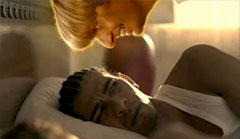


Sadly, the http://toleratemornings.com/ website and all its goodness is no more, and it doesn't ever last on YouTube for more than a few months before being removed. I think Folgers insistence of wiping the commercial from existence on all the video boards shows some backward thinking. After all, this is a commercial that they payed television stations to air and these fans are posting it up on the internet for people to watch without Folgers having to pay another dime. It's a good commercial and they should have made more. Maybe showing the ramifications of a dry dessert that can be overcome by the dark brown richness from a hot cup of Folgers coffee.

Well... here are the lyrics to the best of my knowledge:


[Think Jimmy Durante]
Hah cha cha chahhh
Hah cha cha chahhh

Hello World, we're shining so bright.
A new day's here, it's really dynamite.
Feel the love. Savor the door.
There's a rainbow for each girl and boy.

On this [clap clap] happy morning! (Rise and shine!)
[clap clap] happy morning! (We're doin' fine!)
Get up, get out of bed. You can sleep when you are dead.

Partied hard; stayed up real late.
It's time for work and you can hardly wait.
Scrub-a-dub-dub. Doodily-doo.
Spread the sunshine inside of you.

'Cause it's a [clap clap] happy morning! (Happy day!)
[clap clap] happy morning! (It's nice today!)
Wake up you sleepy head. You can sleep when you are dead ...

You can sleep when you are ... [very bad Yamaha recorder instrumental]

La la la laaa
La la la laaa

[key change - rises like the sun]

Chahhhhh! Happy morning. (Rise and shine!)
Happy morning. (It's wake-up time!)
Wake up you sleepy head, you can sleep when you are ...
[clap clap]
Happy morning. (Happy day!)
Happy morning. (Feel right today!)
Wake up you sleepy head ... [fade]
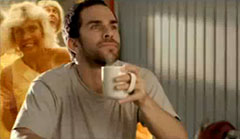
I loved the song so much that I made it into a ringtone (or more appropriately, a wake-up alarm on my iPhone). The audio had to be stripped out of the commercial then carefully amplified and cut to produce the result. Audacity was used for the editing. I can't remember what was used to pull the audio out of the video file.



Happy Morning Short Edit.m4r for the iPhone.

happy_morning_short_edit.mp3 for other devices.

Wednesday, November 11, 2009

Science's marriage to law

Science apart from law doesn't exist.

We have irrefutable laws of math, physics, chemistry and biology from which all other genres of science stem. How is it, then, that any so-called "science" could exist without laws?

Founding fathers of scientific principles believed strongly in a law-giving God. If the God that created the universe provided laws for the most obscure segments, such as the human soul, then He would certainly also provide laws for the more obvious parts of nature. Believing that there is a solid law is what led Louis Pasteur to also believe there is no such thing as spontaneous generation. This belief guided him into being the founder of modern day microbiology against the competition of his pagan predecessors and coleagues who supported an untested belief that spontaneous generation acts as the mechanism for evolution.

Galileo had plenty of difficulties because of the Catholic Church, but he addressed his difficulties as coming from people's blindness both in what the Bible said and in what the Bible didn't say. He's quoted as saying "The Bible shows the way to go to heaven, not the way the heavens go." But he held that observation reveals an order and law in the heavens that supports scripture, and that it's dangerous to blindly accept what politicians tell people to accept as truth since the "truth" of politics can change.

Kelvin, one of the founders of modern day physics and entreated other scientists to design an absolute thermometric scale. His understanding of absolute properties stemmed from his understanding of God: "Do not be afraid of being free thinkers. If you think strongly enough you will be forced by science to the belief in God, which is the foundation of all religion. You will find science not antagonistic but helpful to religion." From this, we infer that he considered a belief in God, and hence religion, to have a foundation that branches out to science and for science to be the process of gathering evidence of God. This only leads to one conclusion: "I cannot admit that, with regard to the origin of life, science neither affirms nor denies Creative Power. Science positively affirms Creative Power. It is not in dead matter that we live and move and have our being, but in the creating and directing Power which science compels us to accept as an article of belief."

I'll close with some thoughts from Isaac Newton. He defined science as the "frame of the world" that isn't random or complex, but as simple as the other laws handed down by God. "It is the perfection of God's works that they are all done with the greatest simplicity. He is the God of order and not of confusion. Therefore ... they [that] would understand the frame of the world must endeavor to reduce their knowledge to all possible simplicity." In other words, the key to the perfect works of a master craftsman is to have perfect adherance to simple rules. Since God's scripture outlines simple rules for living, all other aspects of life must also adhere to simple rules.

Wednesday, October 28, 2009

Parenting Magazine's 25 iPhone Apps For Kids

A couple of days ago, Parenting.com released an article listing 25 iPhone Apps for Kids. Most are paid-for apps, though some are free.

Although it's understandable that they would make you sift through 25 pages to see the entire list, I found it quite annoying and took the liberty of constructing a simplified list below. Furthermore, some of the links they provided were flat-out wrong or don't work and at least one of the apps they suggested was pulled from the iTunes store.

The prices mentioned were taken from the iTunes store. Some prices changed since they posted their article.

Click on the icon to go to the iTunes store.
 
App 1 - Pianist by Moo Cow Music, $3.99


App 2 - Scribble Lite by Zintin, Free

App 3 - iPlayPhone by Ryan Neudorf, $0.99

App 4 - Wooo! Button by TightApps, Free

App 5 - Airport Mania: First Flight Lite by Reflexive Entertainment, Free

App 6 - Toddler Teasers Shapes by Toddler Teasers, Free

App 7 - Jirbo Match : Child Development Edition by Jirbo, Inc, $1.99

App 8 - Penguin Whacker by workavoidance.net, Free

App 9 - Toddler Flashcards by iTot Apps, $0.99

App 10 - The Pool by MarkJ.net (webapp), Free
Point your iPhone Safari Browser to http://www.markj.net/pool/
 

App 11 - Snowman 3D by G.A.M.E.S., $0.99

App 12 - Alphabet Animals - Talking ABC Cards for Kids by Innovative Language Learning, LLC, $0.99

App 13 - Reversi by Kiss The Machine, $1.99

App 14 - Checkers Free by Optime Software, Free

App 15 - FreshWater Aquarium, $0.99

App 16 - Mad Libs Lite by Penguin Group USA, Free

App 17 - Push The Button by Mi Mundo iPhone SL, Free

App 18 - iSign Alphabet by USA-Links.com, Free
Point your iPhone Safari Browser to http://www.usa-links.com/isign/


App 19 - Peanut Butter Jelly Time - Not Available In The U.S.
Removed
Just go to the YouTube app and search for "Peanut Butter Jelly Time". Select the one from AlbinoBlackSheep.


App 20 - WordSearch Kids by AFKSoft, $0.99

App 21 - Tic Tac Toe Free by Optime Software, Free

App 22 - Infinite Maze by Exact Magic Software, LLC, $0.99

App 23 - Wacky Safari by Earblast, $0.99

App 24 - Pegs by Samir, Free

App 25 - Kids Bingo by MathSlice (webapp), Free
Point your iPhone Safari Browser to http://m.mathslice.com

Tuesday, October 27, 2009

The Four Horsemen of the Apocalypse - The Red Horse

Apparently, I'm in good company when it comes to conspiracy theories colliding with Judaeo-Christian beliefs. Former president Hoover mentioned in a 1954 Time interview that he figured the Red Horseman to represent pestilence. Specifically, a revolution. Today the largest political threats also ironically don the red color. Are we in for a communist take-over soon?

Despite what we might have been taught in school, the United States wasn't entirely born in 1776. We were still at war 1783 when the Treaty of Paris was signed, signifying the end of the American Revolutionary War. The Constitution of the United States of America was ratified by most states in 1788. We didn't have a President until 1789. In 1790 the last of the 13 original colonies, Rhode Island, ratified the Constitution. This is why the following chart shows America starting in 1790.

The antagonizing acts of the British went on for ten years from 1764 to 1774, spurring revolts, outcries and vexation across the North American territory. From that point a congress convened and war began against the British, lasting from 1775 to 1781 with the Declaration of Independence written in 1776.

This chart that follows was gathered from a blog that's been spread around the internet by Chuck Baldwin titled "U.S. To Break Up Soon?"

Assyria (859-612 B.C.): a 247-year reign.
Persia (538-330 B.C.): a 208-year reign.
Greece (331-100 B.C.): a 231-year reign.
The Roman Republic (260-27 B.C.): a 233-year reign.
The Roman Empire (27 B.C.-180 A.D.): a 207-year reign.
The Arab Empire (634-880 A.D.): a 246-year reign.
The Mameluke Empire (1250-1517 A.D.): a 267-year reign.
The Ottoman Empire (1320-1570 A.D.): a 250-year reign.
Spain (1500-1750 A.D.): a 250-year reign.
Romanov Russia (1682-1916 A.D.): a 234-year reign.
Great Britain (1700-1950 A.D.): a 250-year reign.
The USA (1790-2009 A.D.): 219 years and counting.

According to this chart, most major world empires in history only lasted an average of 238 years. That means we're statistically due for a political collapse.

According to the Time article
Hoover admits that revolutions may be good or bad, "but St. John's horseman had no good purpose ... We do not allow our imaginations to extend to the idea that St. John was prophesying Communism, even though one is tempted, partly because of the prophetic statement that power was given to the horseman 'to take peace from the world.' "


In 1954, when this article had been written, China had just finished turning over to a Communist government in 1959 and was considered more of a casualty of Communism than a superpower. The main threats to the U.S. were Russia and Japan. Korea was considered a middle domino between China and Japan, hence the Korean war, which ended in 1953. America and its media were hopeful like an arrogant teenage boy, thinking our nation was impervious to death.

Machiavellian politics seem to always ring true. Over time many factors worked at decaying the United States from the inside out, and that greed went as far as the people of the republic. Debt spending went to record highs and in an emotional climax the President was allowed to sign many of the freedoms that represented our sovereignty over in a "Patriot" act. Our current President claimed that we needed to increase debt spending to support our nation. The conclusion is obvious. People are angry with the government. I've been hearing it for years. Anti-American and pro-communistic ideas have been feed to me and my peers all through school and college. Stories of Robin Hood were twisted into a communist slant rather than a true representation of a revolt that happened in Ireland centuries ago.

If China were to call their debt on us, we'd have to concede and pay restitution. Other countries would want their piece of the American soil, too. In a feeble move, the President would have to pull our armed forces out of the Middle East and bring them back to native soil to fight. Many Americans would become civilian minute-men to fight for our President and our country. Other Americans would become revolutionaries and fight for a new order. While we're out of the Middle East, a revolutionary war breaks out there. Israel somehow gains back the holy mound in Jerusalem. Ultimately the Red Horse wins.

From what I understand, Russia is supposed to gain incredible power over the nations south of it, west of it and of some special land elsewhere. Eventually the world powers in Europe, possibly Greece, rise up a leader who mocks God. We know the drill ... 666 and more tribulation. Thus begins the period of the abomination of desolation.

Now comes the question on what to do when the New World Order arises. Fight politically, not physically, and accept captivity into a new Babylon. According to scripture the Jews believed they could get away from their terrible behavior without consequences... they believed they had a right to fight to stay on their land while Babylon conquered them. Even though prophets warned them to just go and not resist, many of them fought and died anyway. If God's chosen ones couldn't stave off their punishment, what makes us think we can do better? Still - before world-wide revolution, there will be the four governments. Before that will be world-wide economic collapse. According to Scripture the end is near but we've got a few years to go.

Friday, October 16, 2009

Stockpiling

So I guess we should begin talking about stockpiling and how it's different than hording. Those who have collecting skills or miserly qualities should easily move well with this skill provided they have a prepared heart. As God's Word states, only those who are righteous, industrious and good stewards will end well: Proverbs 10:3, 11:1, 11:24-26.


  1. Proverbs 10:3 - The LORD will not allow the righteous soul to famish.
    We need to hold ourselves to high integrity and standards in the beginning of these dark times. Be honest and truthful with our words and actions, courageous and dogmatic about what's right, loyal and faithful to God at all costs.
    There's nothing righteous in being angry, inconsiderate, jealous or rude. Righteousness starts by being ready to admit we're wrong, and by acknowledging natural laws that govern us as being universal with accountability.

  2. Proverbs 11:1 - Dishonest scales are an abomination of the LORD, but a just weight is His delight.
    I.E. Don't clock in time you didn't work. Don't say you did something if you didn't. If the United States economy collapses and bartering becomes a popular way of life, remember that God's law states that any cheater pays back seven fold what he stole.

  3. Proverbs 11:24-26 - There is one who scatters, yet increases more; and there is one who withholds more than is right, but it leads to poverty. The generous soul will be made rich, and he who waters will also be watered himself. The people will curse him who withholds grain, But blessing will be on the head of him who sells it.
    Any man who doesn't provide for his family's needs first is a twisted dung heap. After providing for your family, see how you can further sustain your need and others with what you have remaining. Although God blesses those who bless the poor, we need to be industrious in how we help others. Remember the parable of the maids with the oil lamps in Matthew 25:1-13. Although the parable is intended to demonstrate our spiritual preparedness for the tribulation (perhaps even acceptance of the rapture itself) it holds wisdom for other aspects in life. In short, it's the boyscout motto: be prepared.


What should we stockpile? Nonperishable Consumables. These are items that last long on the shelf that everyone uses: Daily necessities such as toilet paper, shaving cream, razors, toothpaste; Cans or packages of food with more than two or three years of shelf-life such as beans, peanut butter and ramen noodles; Extra batteries; Bottled water and water purifiers; "sinful" pleasures such as cigarettes, wine, bottles of rum.

You might not have interests in these items, but others will in a couple of years.

Labels: ,

Thursday, October 15, 2009

Usefulness

Today I have to admit that many of my blog posts aren't useful. Instead of providing information to help others deal with serious, personal issues ... and rather than giving some level of relief or insight, I've bantered about notions and ideas that don't encourage or support people in these difficult times.

The Paurian Cafe started out as a sounding board, but as time passes, and as I supposedly mature, it becomes more apparent that personal sounding boards and web journals generally don't help the public who have an actual and realized need.

What do people need? What do they want? Where are we heading from this point?

Irresponsible people in government have an idealistically optimist outlook. They have for years. A politically influential man told me in June 2008 that we had eight more years before our nation would collapse. That in eight years, we would no longer be "America". He didn't say we wouldn't be "America as we know it," but that we would no longer be American soil. I wish I had started investing in gold then. I thought of doing it last spring, but decided to put that money towards refinancing our house to lower the monthly payments. We're living in times where every decision we make is invariably a bad one depending on who you listen to.

Labels: ,

Tuesday, September 29, 2009

Cold Hard Cash

Just for being in our family the children get approximately $1 per year of age (after reaching 5 years old) each month. It gets divided into fourths and divvied out weekly. For example, one child is 9 years old. I take 9, divide it by 4 and come up with 2.25 a week. I could have used a more accurate monthly-allowance formula: age * 12 / 52. That would, however, come up to $2.076923 for the same 9-year-old. I don't mind the extra 18 cents a week to nicely round up the allowance payments into quarters. And having all those quarters turns out to be important as you'll see.

Why don't we give them a dollar per age per week like the "average" American family? Well... we don't want to give them too much because learning to save and plan for specific "goal" purchases while developing the behavior to fight off impulse purchases work best on smaller allowances. If they could get away with buying impulse items and still get their "goal" item in a short period of time it wouldn't have the same effect.

Here's the "catch":

1. Necessities come from Mom and Dad. Splurges come from your allowance. They were good about not asking for extras before, but now they are ready to learn to ask themselves the value of what they want to purchase.

2. 20% is put in a savings account. 10% is donated and 70% is for whatever the child decides. We help the child learn about saving up their 70% for the toys they want.

3. Chores that aren't finished by a given deadline go up to the lowest bidder who has already finished all his/her chores. The person who was supposed to perform the duty must pay the lowest bidder. For example, if child A doesn't want to wash the dishes, children B, C and D offer their bids to do it. Child A then has to pay the lowest bidder their asking price. It's capped according to the chore and immediate need.

We first tried giving them all the money up front at the beginning of the month. All the excitement fizzled out by the end of the first week.

That's why we divided their age by fourths, then hand out that amount each week (they make a little more money that way, but I don't care as long as they learn good lessons with it).

They can occasionally get paid bonuses for chores that Mom or Dad forgo, provided they have already done their chores. This further motivates them to be done so they have that availability.

Using this method they learn about saving, spending, earning, preparedness, frugality and charity. So far it's working well. We adapted the idea from Jim Fay's Love and Logic.

Labels: , , ,

Thursday, September 03, 2009

The Gender Gap, aka Where's My Sex?

Last February, Family Life posted an article about why women need sex in their marriage. Many responses from women are either chiming in with a pity party or degrading men. These are typical responses from people who don't take responsibility for their actions. When a child misbehaves he or she either tries to divert the conversation to how they were hurt (sometimes as if it were a good excuse for their misbehavior) or they point the finger to someone else.

Somewhere between junior high and college I was given the strong impression that women don't like or want sex. Thinking back, this advice seemed to always come from the lips of very liberal women who despised having any man open the door for them. If women don't like or want sex, why isn't there a movement of women towards celibacy instead of towards lesbianism? Women have been manipulated into a mass exodus from their natural character into rebellion, mutiny and abomination masked in political "rights" to express a hatred towards God and men. Through women "liberation", America has mutated from the moral and Christian principality it was founded upon into a dark shroud of blood-lust mafias, infant holocaust, racist eugenics, Godless schools, sexual disease, diminished parental rights and large Orwellian socialist government. This is not an attack against women. It is an affront to the feminist movement.

Votes for prohibition, which brought about our history's worst criminals and the need for the FBI, was largely in the hands of women. Without the FBI we wouldn't have had McCarthyism go to the extents that it had. Prohibition is the only constitutional amendment that was repealed through another amendment. No other federal law can claim such anarchy to our society.

In Roe vs. Wade, it was a woman who, having consensual unprotected sex, decided she didn't want to live with the consequences of her actions (having to care for a baby). With the help of two female attorneys who exploited the 9th Amendment, she made a legendary case that has caused the death of millions of innocent children who have no choice in the matter ("pro-choice", indeed!).

The woman who founded Planned Parenthood, Margaret Sanger, held a world view stewing with socialism, racism and Nazism so strong that it formed a belief in supportive of eugenics (euthanasia). She originally designed the organization to control the population of lower class and minority citizens - in her own racist words she degraded blacks as being "just a step higher than the chimpanzee" and stated that "the lower down in the scale of human development we go the less sexual control we find." In other words, the abortions and contraceptives provided by Planned Parenthood were originally intended to reduce the population of those driven by lust and ignorance since it was thought that both lust and ignorance were inherited traits passed down from generation to generation. The black community held quite a few uproars about this woman, and rightfully so. She was calling for a silent self-genocide of their population.

Madalyn Murray O'Hair is singularly given the reputation of stopping prayer in schools. When she filed a case against the school board of Baltimore, the local court judge, J. Gilbert Pendergast, mentioned "It is abundantly clear that the petitioners' real objective is to drive every concept of religion out of the public school system."

Katherine McCormick was a devout fan of Margaret Sanger and felt that women - particularly hookers (again, we're talking about lower-class) - should have control over birth control. This meant taking the condom out of the picture since that was traditionally taken care of by the man. Katherine used the excuse of her husband's schizophrenia, claiming it was an inheritable disease, to donate a large amount of money to the research that founded the birth control pill. Because of the birth control pill, a large concern of sexual impurity - the responsibility of having a child - was taken out of the picture. Control and power without responsibility always results in abuse and neglect. In this case the abuse is widespread sexual promiscuity and the neglect is the condom. The result is a continual rise in AIDs and other STDs.

In more recent times, Charlene Nguon is an out-of-the-closet lesbian who sued her school because the principle "violated" her privacy by telling her parents she was expelled for inappropriate sexual behavior (fondling another girl on campus). She claims her parent's didn't have a right to know and her principle didn't have a right to tell them. At home she hid her sexual alignment while at school she uninhibitedly expressed it. Although she lost the case, it was a landmark moment that used the government to pit against the parents.

Most states don't require parental consent for an abortion and those few that still do are close enough to the states that don't require them that it almost becomes a mute point. Hillary Clinton's "It Takes A Village" campaign still goes on, though it's been quite widely rejected. Nobody can take better care of a child than his or her own parent because no other human will love that child more. Do you think the government will love a child as well as the parent? Ask Sally Lieber. Her "never spank a child" campaign and stripped parental rights agenda is leading towards a society of unruly children who grow up to be criminals. The whole "it takes a village" campaign wasn't about people stepping up to take care of other children who aren't their own, it was about big government.

I'm not saying that these women acted out alone, nor am I saying that all immorality comes from women. I'm merely pointing out what advances to moral decline the feminist movement has generated during the past 90 years.

Women decided over a century ago to be "equal" to men. It started under the guise of voting rights. It was a large political campaign pushed largely by feminists who would be better called female supremacists since they believed women to be largely more capable than men. Before that time, voting issues were often discussed amongst women and to their husbands. Husbands held the weighty responsibility to make political decisions that would be best for his family. When women gained their voting rights they stripped men of that responsibility and the culture started moving towards an ever more feminist slant.

It wasn't voting women that ruined American morality or family values. It was the feminist spirit behind it. What many people don't know about the history of "liberation" and "suffrage" is that its core feminist goal was not the 19th Amendment, and not even equality with men, but superiority and dominance above men. Some of that superiority is realized today. For example, it's the woman's legal "choice," not the man's, to abort a child. This upsets the authoritative nature that God placed in society - specifically in the family. God intended for men to be the head of the household. The dad and husband is accountable for the family's well being; even in cases where he doesn't marry the women he impregnates, the government holds him financially responsible. When men are stripped of that authority, they are also stripped of the means - and more importantly, the motivation or desire - to uphold that responsibility, which creates a society of dead-beat and estranged dads.

A conductor of an orchestra can't bring forth any music unless everyone in the orchestra agrees to follow the conductor's lead. That's how the very meaning of "orchestration" came about. When a family isn't orchestrated it becomes chaotic. A chaotic family is not a Godly one. Womankind figuratively yanked the baton from the husband figure when she demanded a right to vote - it wasn't equality, it was rebellion. That was the first step of the feminist movement.

The next step was mutiny, though it's difficult to call it "mutiny" since in the end men became lazy and pretty much just handed over their role to women. Men like William Marston didn't help. He preached a psychology that handing authority over to women demonstrated a higher evolution of society (he lived with two women simultaneously - his wife and his secretary - if you need a moral reference). Men definitely had their hand in the bowl this entire time by promoting, allowing or exploiting the immoral changes to society and the degrading of their own roles. I'm just tired of liberal women arguing with me about how only good has come from "suffrage" and hearing how chauvinistic they think I am. As the Bible commands men to take care of women as the "weaker vessel", it's obvious to any man that you don't carry around a weaker vessel unless there is special value to it - meaning that men should treat women kindly and take care of them like a treasure. Women who wish to be equal with men deserve to be given hardships that were traditionally reserved for men, such as being put on the draft board and stuck fighting a war... such as having to work to provide for a houseful of children; not being able to spend more than a few hours a week with them... such as not being treated with the chivalry or manners due to a lady. That's what women asked for when they signed up to be seperated from their husbands in that fateful 19th amendment. I think men saw the opportunity to find a political excuse to bow out of this sacrificial role and voted for it out of selfishness or constant nagging from a contemptuous wife!

I've been told by very old and scholarly gentleman that this constant sin of women pushing towards individuality away from relationships is the cardinal sin that separates marriages. He specifically pointed a finger at the 19th amendment, stating that it marked the beginning of the destruction. I don't have anything against women voting, but I do have plenty against feminism and I firmly believe that feminism has continually plotted to destroy families; at its core, feminism considers motherhood as the height of enslavement.

There's an old Jewish legend that isn't written in the Torah or the Bible. The legend of Lilith. According to the legend, God made a woman for Adam who was completely separate from him - no rib needed. At first this woman wanted to be completely equal in the marriage on all terms... then she decided she wanted to dominate mankind. In the paradise of Eden there would be no need to have someone provide for you or protect you. The only sign of dominance would then be specific to the act of sex. Lilith demanded to be on top. Adam insisted that it was his role. God was dismayed over the ordeal and banished Lilith to the wilderness where she still lives to this day as a demon who accepts scapegoats (as she considers herself one). God then took one of Adam's ribs to create the next woman who was then not separate from Adam by every nature. Because she was taken from Adam she looked to Adam for some level of guidance and authority. I won't go into whether or not this story is valid in this post, but want to point out that this issue is thought to be as old as time itself. If there's any truth to this story then it marks the first act of sin even before eating the forbidden fruit.

Eve went away from Adam's and God's protection and instruction when she wandered off to the forbidden tree. Ever since then, women have had to fight sinful urges to be more like men in physique (such as wearing short hair and masculine clothing), sexual dominance (such as in pornography and in marriage - like Lilith), and authority (as in taking control over the household and gaining dominant roles in politics).

This movement of women becoming like men has degendered society. Men have lost their role as men. As a society led by feminist undertones presses onward by stripping God out of schools, forcing equality (such as the school-lego-socialist-scandal of 2007 (video)) and pushing a "please yourself" mentality, it was only a matter of a generation - the children of the baby boomers, and many baby boomers themselves - before marriages, once thought of as a sanctified covenant, would crumble around us.

Both genders are players in this problem. Women have chosen to be like men - to strip away those aspects that made men distinct. Men have chosen to be passive and take the easier path. In the same way that the many skills which used to be handed down from one generation to the next somehow became lost in the 1970's, the character of a Man was lost as well.

I believe God placed a natural desire in men to fight the good fight, which includes the right to win the fair maiden. Men want to dominate and become king over their family. Whether they are a harsh tyrant of a ruler or a loving Christ-like figure is a matter of their character and their relationship with God. In a society where this role doesn't exist as a reality, it leaves men with only fantasy to toy with. I think deep down, every woman can only truthfully admit that she wants to be rescued by a knight in shining armor or saved from the clutches of despair by a handsome prince. These natural desires of man to protect and provide for women, and for women to desire being protected and provided for are stemmed from our spiritual needs. When society plants itself against the very laws of nature it only has allusion to look forward to.

In short, harlequin romance novels and soap operas are to women what pornography and video gaming are to men. They are both symptoms and causes of failing roles in marriages. They build up fanciful and unspoken expectations. Women can't get the real thing anymore because they killed it, so they put themselves in stories where men value women above all costs and watch soaps wishing to live out certain roles. Men can't be the real thing anymore because they allowed it to die, so they role play in hours upon hours of video games or watch another beautiful woman submit to him in pictures. This causes men and women to separate spiritually, socially and sexually within their marriages. Eventually, if not addressed, it ends with physical and marital separation as well.

I suggest re-learning our roles as scripture points out. Play out these roles both fancifully and seriously in our marriages. For example, dress up as a couple for a Renaissance festival as a damsel in distress and a valiant knight. Go camping and have the man fish and prepare his catch for the woman to cook. Define "manly" and "womanly" household chores. Have the man pull back the chair at the dinner table and open the door for the woman. Learn chivalry and manners as a history lesson - the reason for some of these customs gives insight to the heart and place of the manly role back in the mid to late 1800's.

On stage not all parts are equal. In politics not every one plays president. God created tiers of authority and responsibilities to each role. Why have people stripped these natural boundaries from family and marriage? Put them back where they belong.

Labels: , , , , , , ,